Revenue Process Audit · Q2C Readiness

How much is a manual revenue process costing you?

Let's measure it.

A focused, expert-led analysis of your quote-to-cash process — mapping complexity, surfacing bottlenecks, benchmarking against your industry, and quantifying the business case for automation.

Free 20-min scoping call. No pitch — just a fit check.

Methodology used on engagements at ResearchGate, Magnolia & SWEEP

Not ready to talk yet? Get a sample benchmark report sent to your inbox.

1–5%

of annual revenue lost to billing errors & leakage

3–7×

longer quote cycle times vs. best-in-class

43%

of mid-market still quoting in spreadsheets

5–10

Consulting days to a board-ready business case

*Figures are industry-range benchmarks used for illustration

Is this you?

The signs that your revenue process is ready for a proper diagnostic.

This isn’t only for Salesforce customers — it’s for any company where the gap between how revenue works today and how it could work is costing real time, money, or confidence.

01

Quotes are built in Excel, Word, or a homegrown tool — and the process is slow, error-prone, and impossible to audit.

02

Reps apply discounts inconsistently, and nobody has a clear view of who approved what or why.

03

Deals stall internally more than they should — approvals, pricing sign-off, and contract reviews each create their own queue.

04

Renewal and upsell opportunities are missed because nobody’s tracking contract end dates and entitlements systematically.

01

Invoices go out with errors because the quoting and billing systems don’t talk to each other — someone reconciles manually every month.

02

There’s no single source of truth for contracted revenue, and the data in CRM, ERP, and billing rarely agrees.

03

Revenue recognition is done manually or semi-manually, creating audit risk and delaying close.

04

You’re being asked to support a scaling business on a process that was designed when the company was a third of its current size.

01

You know your revenue process is a constraint on growth, but you don’t have a clear picture of exactly where, or how much it’s costing.

02

Someone has brought up ‘we need a CPQ’ or ‘we need to fix our billing’ — but there’s no concrete
business case to evaluate against the investment required.

03

Time-to-close is longer than it should be at your stage of growth, and deal velocity has become a
board-level concern.

04

You’re heading into a fundraise, acquisition, or due diligence process and want your revenue operations to hold up under scrutiny.

What you walk away with

A fact-based answer — not a vendor recommendation dressed up as analysis.

Process map & complexity assessment

A documented view of how your quote-to-cash process actually works today — handoffs, tools, manual
steps, and where complexity accumulates.

Bottleneck & leakage analysis

The specific steps where time is lost, errors enter, or revenue slips through the cracks — with an estimate of what each is costing in time and money per year.

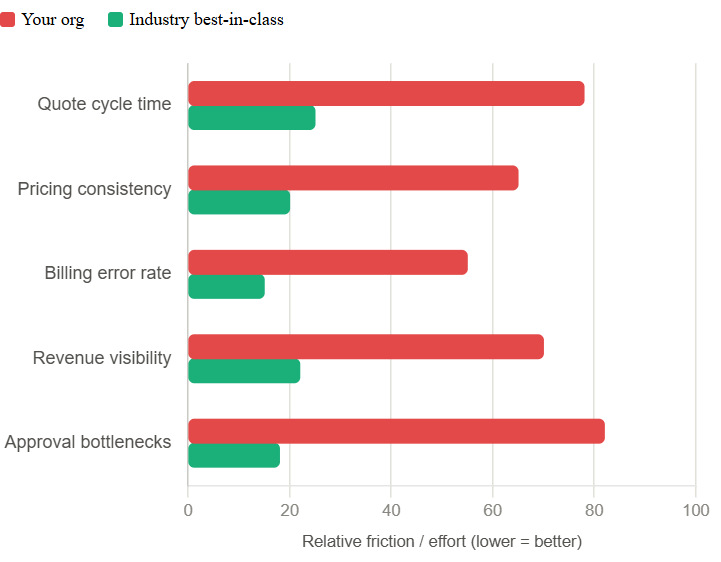
Industry benchmark comparison

Where you stand vs. companies of similar size, complexity, and sector — across quoting speed, pricing
consistency, billing accuracy, and revenue visibility.

Quantified business value & ROI

A business case your CFO and board can evaluate: what automation saves, what it generates, and what the cost of inaction is per quarter.

Technology fit & vendor shortlist

An honest recommendation of what type of Q2C solution fits your complexity level — and whether Salesforce Revenue Cloud is the right fit, or not.

Phased implementation roadmap

What a move to an automated Q2C setup looks like: phasing, rough timelines, investment range, and a recommended pilot scope to de-risk the first step.

How it works

Four workshops. Three to five weeks. Your process, measured against the market.

01

Discovery

Map how revenue works today

We run structured interviews with Sales, RevOps, Finance, and IT to document every step of your quote-to-cash process — from initial pricing through to invoice, payment, and recognition.

Deliverables

End-to-end Q2C process map

Tool & system landscape

List of manual touchpoints & workarounds

02

Analysis

Find the bottlenecks and what they cost

We apply a structured diagnostic framework to identify where time, money, and accuracy are being lost —
and put a conservative annual cost estimate against each gap we find.

Deliverables

Bottleneck prioritisation matrix

Revenue leakage estimate

Friction-to-cost mapping

03

Benchmarking & Value

Compare against best-in-class and build the case

We benchmark your process against industry peers, quantify the gap, and build a business value model —
ROI, payback period, and KPI impact — that leadership can take to a budget conversation.

Deliverables

Industry benchmark comparison report

Business value model (ROI, KPI impact)

Cost of inaction analysis

04

Recommendation & Roadmap

A clear path forward — with options

We recommend the right type of solution for your complexity, present a phased roadmap, and produce a board-ready readout deck your team can present directly to stakeholders.

Deliverables

Technology fit recommendation

Phased implementation roadmap

Board-ready readout deck

PACKAGES — PRICING TIERS

Start lean or go deep — depending on the decision you need to make.

Pricing is confirmed after a short scoping call, where we’ll recommend the right fit based on
your process complexity and what you need to prove internally.

Deliverable

Essential

Most chosen

Full Audit

End-to-end Q2C process map

Bottleneck identification

Revenue leakage estimate

High-level

Detailed per bottleneck

Industry benchmark comparison

Business value model (ROI & KPI impact)

Cost of inaction analysis

Technology fit recommendation

Generic

Tailored to your complexity

Phased implementation roadmap

Board-ready readout deck

Live Q2C demo (tailored to your use cases)

Duration

2–3 weeks

3–5 weeks

Effort

5 consulting days

10 consulting days

Most clients choose Full Audit when they need to justify budget approval internally. Essential fits teams that need a rapid process snapshot before committing to deeper work.

Why Cloudity

You're not getting a consultant's opinion. You're getting a measured diagnosis.

01

We're not selling you a product — we're answering a question

This engagement exists to give you a fact-based answer: is automation worth it, what kind, and what will it actually cost and deliver? If the answer is ‘not yet,’ we’ll say so.

02

Benchmark data your peers have already validated

We bring industry benchmark data built from real Q2C engagements across manufacturing, SaaS, financial services, and professional services — not generic analyst reports.

03

10+ years of Revenue Cloud & Q2C implementations

Our diagnostics are run by practitioners who’ve built and fixed Q2C processes — so we know what ‘good’ looks like and can see around corners that a generic consultant would miss.

04

Output your whole org can use

The readout deck is built to be presented by your internal champion without modification — to your board, your CFO, or your IT steering committee. No translation work needed.

We went from completely guessing whether our Salesforce infrastructure could handle our scaling transition to presenting a board-ready business case to our steering committee in less than a month.

Commercial Operations Lead (Enterprise Tech Engagement)

Find out what your revenue process is actually costing you.

Most companies are surprised by both the size of the gap and how quickly it can be closed. A scoping call takes 20 minutes — and you leave knowing whether this engagement makes sense for where you are right
now.

No commitment. No pitch deck on the first call.

1.

We confirm your process complexity and whether Essential or Full Audit fits better

2.

We align on timeline and who needs to be in the workshops

3.

You leave with a clear next step — no obligation either way

Dima Rashidov

Revenue Cloud Account Advisor

FAQ

Good questions to ask before you start.

Do we need to already be using Salesforce or any CPQ tool?

No. This audit is designed for any company that manages revenue through a combination of tools, spreadsheets, or manual processes — regardless of what’s in your stack today. In fact, companies without an existing CPQ are often the best fit, because the business case tends to be clearest when the current process
is entirely unstructured.

No. The technology recommendation is one of the last outputs — not the starting point. Our job is to understand your actual complexity and commercial model first, then advise which category of solution fits. That might be Salesforce Revenue Cloud, a lighter CPQ tool, or a phased build within your existing ERP. We’ll say which, and why.

Typically: someone from Sales or RevOps who owns the quoting process, a Finance lead who handles billing or revenue recognition, and an IT or CRM contact. We don’t need everyone in every workshop — we’ll align on the right setup in the scoping call.

Complexity is the point of this engagement. We’ve run Q2C diagnostics across manufacturing, SaaS, financial services, professional services, and telecom — all of which have their own commercial structures and billing rules. The more complex your process, the more valuable the structured analysis tends to be.


You’ll have a phased roadmap and a technology recommendation in hand. If you want to move into implementation with Cloudity, that’s a conversation we’re happy to have — but the audit output is yours to take anywhere. It’s not a qualifying exercise for our implementation pipeline; it’s a standalone deliverable.